Being Grateful For A Sandwich Made of Love And Three Books in One!

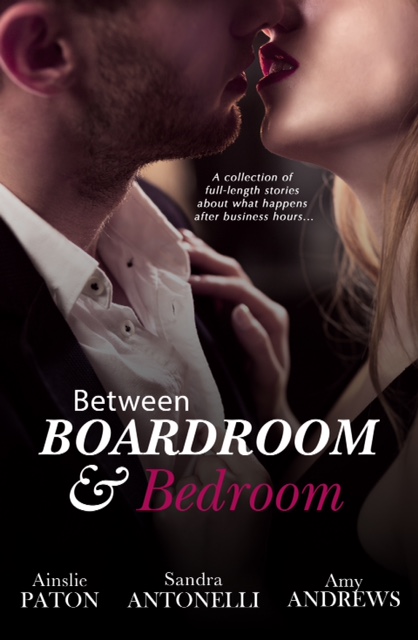
boardbedThis comes out on Saturday. I’m snuggled between two amazeballs authors.

I’m like the meat in the LOVEWICH!

Feel the love.

Taste the Love.

Have a bite of Ainslie Paton, Amy Andrews, and me!

Here’s MORE LOVE:

I’m thrilled to be in the company of such wonderful authors. Not only are these women brilliant writers they are incredibly supportive and generous to other writers. I am constantly blown away by the level of their generosity to the romance writing community, and, personally, by how they have encouraged and supported me over the years.  Truly, they shine as writers and as human beings. I am humbled by their skill with words, but more so by their skill as human beings.

So here’s where I say thank you to Ainslie Paton and Amy Andrews, and to our wise publisher, Escape Publishing, for snuggling me in the middle of you both. Thank you. Thank you. I hope you two rub off on me.

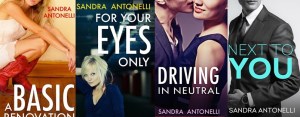
Between Boardroom & Bedroom is: A collection of full-length novels about what happens after business hours…

Insecure — Ainslie Paton

The worst thing a man can do is not be with the woman he loves.

Jacinta was the CEO in waiting. Mace was the geek from IT. She had an office suite on the top floor. He worked in cubicle hell.

She had power, influence, her life mapped out. He had big dreams, and an appetite for risk.

They had one hot night written all over them, except the city conspired to turn that night into a weekend of unexpected passion and deep connection.

Will love be enough when Jacinta’s star falls and Mace’s dream takes flight, or will ambition, expectation and insecurity pull them apart?

Driving In Neutral — Sandra Antonelli (that’s me!)

A quick-witted romance about facing your fears — like love, the greatest risk of all.

Levelheaded Olivia Regen walks away from her car-racing career and the wreckage of a bad marriage to take on new work that’s far removed from the twists of racetrack. Her new life is about control, calm, and the friends that she adores.

But her first day on the job involves getting up close and too personal with her claustrophobic boss, alone in a broken elevator. Her unconventional solution for restoring his equilibrium shocks them both– leaves Olivia shaken.

Determined to stick to her plan, Olivia drives headlong into work and planning her over-anxious best friend’s wedding, leaving no room for kissing, elevators, or workplace relationships. But Emerson is not one to be out-maneuvered. Can he convince Olivia that her fear of falling in love again is just another kind of claustrophobia — one that is destined to leave them both lonely?

Risky Business — Amy Andrews

From bestselling author Amy Andrews comes a new romance about putting pleasure before business.

Samantha Evans’ life is going to hell. Not only has she rage-quit her beloved high-powered job, but she is suddenly afflicted by hormones, free time, and an unavoidable, undeniably gorgeous irritant in the form of Nick Hawke, her neighbor, an extreme sports star who has come home to take over the reins of his grandmother’s second-hand bookshop. Sam needs something to keep her from begging for her old job back and helping Nick at his bookstore might be just the thing.

Nick has six months to get over an injury. That means no sports, no danger and, above all else, no risks. It means playing it safe. And what could be safer than hiring a cranky, unemployed accountant to help run the bookstore? Sam is efficient and methodical and messing up her neat, post-it note world could be a fun way to pass the time…

That’s My Job

book-2The other day, over coffee in a café with a writer friend who lives around the corner from me, the topic turned from our writing to the great mystery of promotion and the elusive magical unicorn that leads readers to your books. We discussed when your new book comes out strong, gets well-reviewed, and then…slips into something like a zombie-like state where sales shuffle along, taking an occasional bite here and there. My friend and I wondered how much promo can you do for yourself, how can you market your work and get it noticed, get it ‘discovered’ without being annoying or spending a fuckton of money by hiring a marketing & PR firm.

Fun fact: Did you know fuckton is a now a standard unit of measurement?

The two of us talked and talked — and didn’t come up with any answers, had no suggestions to make, and we went back to sitting side by side drinking coffee, wearing headphones and writing. Because that’s what we do. We meet,we write, and drink coffee.

book1Like my friend, I’ve followed the advice I’ve been given, done blog tours, sent my books out for reviews, peddled my publications on Facebook, Twitter, Wattpad, Pinterest, in newspapers and local magazines, and radio, on my website, on other’s websites. I’ve gone to conferences, presented workshops and papers, and my books continue shuffling along. What I can say is that, while we spent quite some time discussing what to do, I don’t worry about my books doing a zombie shuffle. I set my focus on writing books. I write because THAT’S MY JOB.

I will be totally honest. I don’t write to make money. You may call bullshit on this, but  I have a great life and I do not define myself as a human being by the amount of dough my books do or do not bring in. As a pragmatist, I know this business is a crapshoot, that there are a shit-ton (slightly smaller than a fuckton) of writers and books out there, and very, very, very few make any real sort of money from the work. Making lotsa money would be nice and I’ll admit that royalties are kinda awesome, mostly because they keep me able to sit in a café, drink coffee and write, but as pleased as hell as I am when someone reads my work and buys me another cup of coffee, I do not write my books FOR anyone other than myself. I’m my own audience. And I know what I like

I started writing because I couldn’t find what I wanted to read, which, by now, all of you probably know that’s stories with women over 40 as the lead. Some of you out there happen to like what I like, and like what I write, and that’s totally bitchin’! Thank you for buying me coffee!

While my next two books continue my placing a 40+ woman as the heroine, they are a sligantonellicoverssmallht departure from my usual romance snark, and I still wrote them for myself first. I also wrote them for my friend Elle because she shares my love of coffee and the Bond movie Quantum of Solace. Cult status, coffee money, and Elle aside, what I’m pondering again today is this:

  1. How soon is too soon to market and promote a new book? If I begin this Friday, as I had planned to last week, will it be overkill of the fuckton of promotion?
  2. Is it too early for promo, considering that one of the books has garnered a little interest, but no publishing deal—yet.
  3. Is it too early for promo if I indie publish it and become a hybrid author, and if so see question 1?
  4. Is it possible to overfeed the elusive unicorn and kill it before it has a chance to become a zombie book?

The point of all this is that I am a writer. I am not schooled in marketing or promotion—I don’t even know if there’s a difference between marketing and promo. I am a writer and a coffee drinker.

Maybe one of you could mull this over and get back to me while I’ll carry on writing to please myself, drinking coffee, because contemplating the path to ultimate promomojo sure does get in the way of my job.

The 3 or 5 Hats of Sandra Antonelli

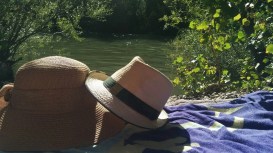
hatsjpgLast week was a busy one. Like Bartholomew Cubbins, I wore a lot of hats– not quite 500 hats, but  3 or 5, which is a lot of hats when you’re a little over 5 feet tall.

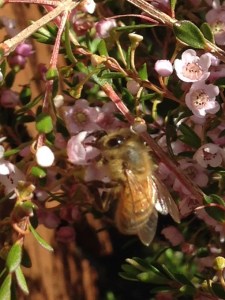
My first hat was a holiday hat. Dr Shrinkee and I flew to Adelaide–a city in South Australia that was NOT settled by convicts transported for stealing a loaf of bread. We rented (or hired as we say here) a Toyota Something Silver Sedan with a giant trunk (boot) far too large for the ONE piece of luggage we shared, and drove around wine country where I took lots of photos of bees doing their bee thing because bees are awesome.Bee1

The holiday hat was put away when I went to attend the Romance Writers of Australia Conference in the seaside Adelaide suburb of Glenelg. I was at the conference to do the sort of stuff writers do at writers conferences such as meet romance industry types, like agents and editors. Hat No. 2 was kind of something of a fedora that I did a nervous Jimmy Stewart-esque fumble with while I pitched At Your Service, the story of a butler, her boss, her dead husband, a missing trust fund, and a deadly toilet brush to an editor at a well-known romance publishing house.

I wasn’t half as nervous about the pitch as I was the fact I had interviewed the editor back in 2012, when I was in the middle of my doctoral research on why publishers wrinkled their noses at older romance heroines. The mind-blowing thing about the pitch was the fact the editor remembered me. The other mind-blowing thing is that she wanted to read the full manuscript about the butler, her boss, her dead husband, a missing trust fund, and a deadly toilet brush.

The third hat was one I shared with Dr Shrinkee as we presented a a workshop together at the Romance Writers of Australia Ain’t Love Grand conference.  The workshop was titled  Personality Goes a Long Way: Is Your Bad Boy a Psychopath or A Dude with ‘tude? As you can imagine, what with Dr Shrinkee being a psychologist at a WRITERS conference, the workshop was all about crafting characters with believable personalities–good guys and bad guys.

Hat No. 4 was one of those English style floppy bonnets university graduates and academic types in the UK and Australia wear because I presented an academic paper at the University of Love conference that ran concurrently with the RWAus’ Ain’t Love Grand.  You know my paper was ALL ABOUT placing women over 40 as protagonists in romance fiction– the stuff that I discovered in my doctoral research, the stuff I go on about ALL THE TIME.  The paper was titled The (Saggy) Bottom Line: Women of a Certain Age and Romance Fiction.

Aside from speakiBee2JPGng a little too fast (I was excited) and not being able to hear the awesome clip from Amy Shumer’s Last Fuckable Day (Go watch it RIGHT NOW), I did rather well. I was surprised by the number of questions I fielded. I still sometimes think that I’m shouting into the wind about ageism, stereotypes, and the need for broader representation of women of a certain in romance fiction. However, the questions I was asked provide more evidence that readers want to see themselves, or people like them, represented in romance fiction. I was very HAPPBEE to learn that.

See what I did there?

Side note: I am grateful that Kat from BookThingo kindly tweeted bits from my presentation. Thank you for that Kat. Thanks also to Kaetrin from Kaetrin’s Musings and Dear Author for giving a wonderful wrap-up of the RWAus Ain’t Love Grand and University of Love conferences, as well as mentioning our ongoing differences of opinion on whether Gone With the Wind is a romance or not–I say yes, Kaetrin says NOOOOOOooOooOo!

I never saw hat 5 coming. It was half hidden by the ENORMOUS mountain of laundry and dust bunnies that had accumulated after a week away from home. I am happy to say I washed (an ironed) everything and vanquished vicious dust bunnies like a badass in a laundry drudge’s bonnet.

Older Broads Are The New Box-Office Powerhouses. Are You Listening Romance Publishers?

Wielding my Shield of Smartass

Wielding my Shield of Smartass

As part of the ongoing expansion of The “Mature” Content Stockpile of articles regarding women and age on this website, I keep track of news and other items I can add to the stockpile. When I came across this fab piece by Mark Harris from NY Mag over at Vulture you know I fist bumped myself, and OH YEAH MAMA-ed while I jumped all my about my kitchen. I was so loud, so exuberant, the builder installing insulation in my garage called out to to make sure I hadn’t hurt myself.

The article is titled Actresses Over 60 Are the New Box-Office Powerhouses.  As I read, the line that first stood out is pretty much what I soapbox about on a regular basis. Harris mentions “society’s tendency to write off older women as dear little “characters” without passions or aspirations of their own.” Then Harris goes on to discuss a 1968 study in Hollywood that examined the age demographics of film-goers.  It’s that paragraph that truly hits home; it’s what I say about a certain overlooked demographic of romance readers with an appetite for a certain overlooked subgenre of romance fiction–the Older Romance, Mature Romance, Mid-Adult Romance, Seasoned Romance, Contemporary Adult Romance. 

The audience is real, and so is its appetite. And those who get it — who don’t simply view this particular group of movie lovers as the “about to die” demographic — may, a few years hence, look like very smart early adapters. In 1968, well before demographics were a subject of serious discussion at the studios, Variety reported the results of a study that showed 48 percent of American moviegoers were 24 or younger. For the middle-aged men who then ran Hollywood and thought they were making movies for themselves, the news was revelatory. Baby-boomers — the pig in the python — were coming of age, and over the next 15 years, the way movies were conceived, made, and marketed would undergo a revolution as a result. Now, almost 50 years later, that demographic is coming of old age, and making itself heard again. And if anyone wants it, they’ve still got money to spend. —(Harris, 1 Aug 2016)

Did you notice that first line Early adapters are smart?

Did you notice the last line? That last line means I have to rewrite a small part of an academic paper I am presenting at the upcoming University of Love conference in Adelaide, Australia. My paper is titled The (Saggy) Bottom Line: Women of a Certain Age and Romance Fiction. I have to include what Harris says alongside what a few other studies and authors note. That last line is a big fat flag I wave when I’m on my soapbox, a big fat signpost that is being overlooked by the publishers of romance fiction.

In case you missed it, because romance publishers miss it, so it must be easy to miss, that big fat signpost is MONEY.

I’ve said it before, I say it in my paper presentation, and I’ll say it here again, There is a demographic of romance fiction readers  who MATCH this demographic of film-goers, and this demographic wants romance fiction that reflects the reality of their lives, not some hackneyed stereotyped bullshit about how a woman over 40 is dead below the waist, or, as Harris mentions, are people who buy “adult diapers and medic-alert systems and sit in their adjustable beds leaning forward with ear horns to make sure they hear the list of dangerous side effects in the commercials.”

This demographic wants romance fiction with heroes and HEROINES who are whole, intelligent, vibrant, active, sexual human beings, not diaper-wearing crazy, cat-loving, dried-up-old grannies with walkers. This demographic of romance reader wants a romance heroine who is like any romance heroine, only she just happens to be older. This demographic of romance reader is trying to make itself heard, and they have money to spend.

This Demographic HAS MONEY TO SPEND! What are you romance publishers waiting for? Early adapters WIN! Romance has been the Early Adapter of so many social changes regarding women– until now, and the industry is missing this goldmine right in front of them.

Thanks to Mark Harris for making me have to rewrite a small section my paper. I have to include this article because he’s given me more evidence that the romance publishing industry is overlooking a goldmine.

The Ick Factor and You: The Origin of the Notion Older People Having Sex Is Gross

Sometimes it doesn’t take much for me to jump on my soapbox. Last week, after I read Ann Brenoff‘s column Dear Hollywood, I May Be Invisible To You, But I’m Very Real on the Huffington Post I got in quite a lather (see what I did there, soapbox, lather?) with another reminder of the ‘culture of invisibility’ in Hollywood. You know the thing, that misguided idea that deems any woman over 40 as unviable, unwanted, unfuckable, unbankable onscreen. All lathered up, I pondered, again, the source of the idiotic invisibility. Since I have a PhD and wrote a dissertation that examined the culture of invisibility in romance fiction, I’m going to share my theory with you.

wtfRemember when you were 5 years-old, and your mother explained the penis and peegina* sex thing that time you were precocious and asked at the dinner table one night? Remember when, a short while after learning the revolting details of where babies came from, you realized that all the kissing you saw on TV, and in movies, was another incomprehensibly revolting thing that grown-ups like your parents did, and you thought every time your parents kissed they were trying to make a baby and you couldn’t fathom WHY your mother would let your father put his penis in her peegina?

Do you also remember how incredibly disgusted you were, but how your confused little kid mind tried to make sense of how you didn’t get pregnant when Raymond Michaud kissed you that time you played in the treehouse the big kids built in the woods near your house?

Remember when the whole notion of sex was absolutely repugnant and then one day it wasn’t? It didn’t seem that far-fetched or icky. But then, when you were about 11, your older brother told you about anal sex and you were all sex was never going to be something you did.

Ever.

Remember when you were 17 or 19, or 22 and kissing and sex was like perpetual springtime and a raging thunderstorm of emotion and passion and excitement? Remember when you joined the club you never thought you’d join? You wondered how you ever thought sex wasn’t something you would want to DO and be DONE TO, and you finally, FINALLY got why everyone on TV, in books and movies wanted to do it. Everyone had sex, all the time—except your parents.

Or grandparents.

Or your unmarried, forty-something aunt.

You thought this because never saw parents or grandparents or spinster aunts on TV, in books or movies doing it or even interested in doing it. They were too mature, tool old, too busy with work and retirembunsent, and went to bed early after their 4:30 dinnertime. And movies, books, and TV didn’t lie. The message was subtle, but you noticed, unconsciously, that people only ever had sex when they were young. You never saw people over 40, like your grandparents, kissing or groping, grinding, or dry humping on TV, in books or movies, and because you never saw it the idea of people over 40 kissing—or humping—was as incomprehensibly revolting as your mother letting your father put his penis in her peegina. The only reason your parents and grandparents still kissed was because they were Italian, Italians are affectionate, and that sort display of affection was allowed on TV, in movies and books. Your parents and grandparents weren’t really passionate because passion was for the young. The perpetual springtime raging thunderstorm of emotion and passion and excitement was for the young you saw on TV, in movies, in books, in romance fiction.

The images of youth are everywhere in the media, on TV, in books, movies, advertising, and this is the insidious way the Ick Factor is enacted. You are indoctrinated without knowing. You are misled to believe sex and passion is only for the young since that is all you see. This perpetual lack of truth is the way stereotypes of age and sex are maintained. The erasure of a huge portion of the population from view has led to the notion that sex is something only human beings under 40 want and enjoy. But it’s worse. If you’re a woman, you notice there’s a double standard when it comes men and women and sex. As you get a little older, maybe when you hit 30, you realize there’s an additional aspect to the Ick Factor you didn’t notice before, when you were younger. Men over 40 continue to get it on in books, movies and on TV.

Women grando not.

Even more sinister is way the Ick Factor works, the continual lack of truth is the way stereotypes of woman and age are maintained, the way women over 40 are cast in stereotyped roles (Hey, grandma!) or dismissed, excluded from appearing on TV, in movies and books. This is truly incomprehensibly revolting, and this is how we are conditioned to think. We erase women over 40 from being when we know this is NOT how women over 40 are.

In a world of reality television, isn’t it time to change the Ick Factor to a Truth Factor? Isn’t it time we show life as it really is, show people of all ages as whole, passionate, sexual human beings in love? Isn’t it time we grow up from being grossed out little five year olds who can’t comprehend how mommy would let daddy put his penis into her peegina?

I battle the Ick Factor. I write books that challenge the ‘younger’ norm of romance fiction. My lead characters are all over 40; the romance heroines are older than the standard twenty-something romance heroine.  The women I write are whole, intelligent, vibrant, sexual humAntonellicoverssmallan beings, not stereotypes of age. I write outside the norm because I believe it is beyond time to change. Discussing the Ick Factor and the ‘culture of invisibility’ is excellent, important, but what good is all the talk about age discrimination and sexism if no one challenges the ‘usual?” For decades, Romance fiction has been at the forefront of adapting to social and cultural change for women. What better place to shift the attitudes about women age, sexuality, make women of a certain age visible, and kill the Ick Factor?

Trust me on this. I’m a doctor who writes romance fiction.

*Becasue Pee comes out of a boy’s penis and pee comes out of a girl’s peegina

I Can See Clearly Now: Next to You and How Come You Did That?

Here’s the question I’ve been asked the most about my upcoming release Next to You:

“Why an a hero with albinism, Sandra?”LittleWill

My answer? Contact lenses and an old friend.

I wear hard contact lenses and I have a very fair-skinned dear friend who wore an eye patch when he was a kid. That’s him over there.

Yeah, yeah, how cute and all, but what’s that kid got to do with a hero with albinism?

Know how what you see isn’t always what you get, and how looks are deceiving, and that love is blind? I’m myopic (near sighted or shortsighted if you prefer). I also have astigmatism plus, being middle aged, presbyopia. Soft contacts won’t correct my crappy vision. A soft lens won’t sit properly because my astigmatism is too severe. Glasses don’t even give me great distance acuity. Rigid contacts, however, correct my vision quite nicely. Fortunately, rigid gas permeable contacts are a special order item that last a long time, Unfortunately they’re not cheap. The thing is, NextToYou_V1_Round3-Harlequin1920_1920x3022twelve years ago, when I wrote Next to You, which was then titled A Simple Overexposure (if you read the book you’ll pick where I got that title), I needed new contacts, and it was getting difficult to find an optometrist to fit them and keep the cost under $400.

Being such a tightwad back then, I went online to find companies that manufactured hard contacts, so I could purchase them directly—cheaper than I could from my $400 a pair optometrist. What happened during my search for cheaper is that I came across an article discussing hard contact lenses and vision correction in people with albinism. The article mentioned the use of an eye patch for amblyopia and strabismic amblyopia. Immediately, I thought of that fair-skinned, eye-patch-wearing kid up there, my dear friend, whose name happens to be Will—or The Dread Pirate Will, as he asked to be called in return for letting me use his photo in this post.

lens

maikel_nai via StoolsFair / CC BY

After some fond memories of Will, ones that involved us fake sumo wrestling and going to Monty Python film festivals, I found myself nerding out, reading more about vision conditions like strabismus and nystagmus–eye conditions people with albinism often have.

Then, I nerded out even more and began reading more and more about albinism, about the myths, the stigmatisation, and the stereotypes so often associated with the condition. In a bizarre way the stigmatisation and stereotypes reminded me of the way women of a certain age are stigmatised and stereotyped. I thought how stereotypes are, at their very root, a vision problem that can’t be corrected with contacts or an eye patch.

Suddenly, I had this image of middle-aged man with albinism; it was William Murphy, the suit-wearing, bubble-gum pop-loving hero of Next to You, and I knew there was more to this Will than meets the eye.

Five minutes after seeing Will’s image, I saw Caroline, a middle-aged, introverted, movie-loving  heroine who isn’t exactly what she seems—because what you see isn’t always what you get, looks are deceiving, and love is blind.

Kind of like me without my contacts or glasses.


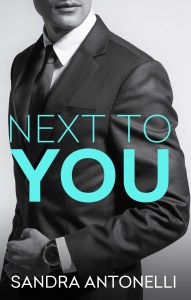
Next to You is out 25 July. You can preorder it now, from all the usual places:

Amazon, iTunes, GooglePlay All Romance

Writing a SymPathetic Villain

villainThere’s a fine line between love and hate, between madness and sanity, between a caricature and a character. It’s easy to paint a villain with broad strokes, make her or him larger than life–like the bad guy in a Bond movie.  But how does one create a villain whose villainy is a matter of circumstance, an individual who, under normal conditions, would actually be a pretty fun guy?

How does one make a character who does awful things elicit pathos in a reader?

Alice Sebold did this in her book The Lovely Bones. If you’ve never read it (or seen the film) it’s the tale of Susie, a girl who is kidnapped, raped and murder by a neighbour. The neighbour, Mr Harvey, is an utterly abhorrent, ghastly, depraved man, a serial killer, and Sebold manages to show his desperate loneliness in how he lives alone–and builds doll houses, which is creepy…and pitifully heartbreaking.

That small thing, the man alone building doll houses, was enough of an appeal to my emotions as I read the book, and, despite all that Mr Harvey had done, I remembered the loneliness that I had once experienced in my own life–and I felt pity for the man. Granted it was a fleeting sensation, but Sebold kind of blew me away with her skill as a writer.

When I wrote Alex, the villain in Next to You, I never really thought of him as a villain. CHIN NextToYou1920_1920x3022_1024I thought of him as the redheaded actor Eric Stoltz, a good-looking good guy having a really shitty year after a family tragedy and being dumped by the love of his life.

People do all sorts of less-than-intelligent things when life goes to hell. Alex walks that fine between love and hate, between madness and sanity, between wanting to do the right thing and winding up doing the wrong thing. I know what I wanted to do with Alex when I wrote him. I wanted to pull off a Sebold and show his humanity. I wanted the reader to have a little sympathy for him–in spite of his despicable actions.

Although it’s available for pre-order and on Netgalley for reviews, with the book’s release a little over a month away, it’s too early to tell whether I managed a balance between caricature and character with Alex’s reprehensible behaviour, if he comes across as simply a villain, or if he’ll elicit pathos of any kind from readers. Perhaps readers will find his desolation pathetic rather than sympathetic. However, I am hoping that someone besides me feels, for at least a fleeting moment, pity, or recognises his frail humanity.


Erroneous Beliefs and Myths Influenced by Superstition and Stereotypes

UNIn 2013, The United Nations Human Right council adopted a resolution making today, 13 June, International Albinism Awareness Day.CHIN NextToYou1920_1920x3022_1024

My book Next to You features a romantic lead with albinism and a deep abiding love of 70s Bubblegum pop songs. The book is due for release on 25 July, but is available for preorder on Amazon, review on Netgalley, and is also up on Goodreads.  Yay, right? Okay but why did I write a character with albinism?

A rather obvious parallel. Read on and you’ll see what I mean.

The un.org information regarding International Albinism Awareness Day states, “The physical appearance of persons with albinism is often the object of erroneous beliefs and myths influenced by superstition.” Even in the western world, images of albinism are often based on myths and superstition. Naturally, this is something William Murphy, the silver fox hero of Next to You understands. Will tries hard to educate other about the genetically inherited condition that affects his skin and, to less of an extent than many others with albinism, his vision. By the way, Will’s silver foxy because he’s 56, not because he’s albino.

I tried hard to dispel myths about albinism in Next to You, because when I began writing the story, so many years ago, I was surprised by how few accurate representations of persons with albinism there are. When was the last time you saw a person with albinism portrayed onscreen, in a book, comic, or graphic novel in a role that wasn’t a stereotype of evil or comic relief?

That sounds familiar, doesn’t it?

Usually I soapbox about the representations–or lack thereof–of women over 40 in romance fiction. I write women of of substance, not tokens, comic foils, secondary characters, or worst of all, stereotypes: the crone, the crazy cat lady, the granny, the cougar. I write for a female audience that can see themselves, not as cat-ladies, crones, or knitting-cookie-baking grannies, but as regular women—who just happen to be older. Next to You is no different. Caroline is over 45, Will is older and just happens towitch have albinism.

Have a look at the UN’s statement again: The physical appearance of persons with albinism is often the object of erroneous beliefs and myths influenced by superstition.

Modify the statement slightly: Older women (or Older people) are often the object of erroneous beliefs and myths influenced by superstition. 

There you have my reason. Marginalised populations.

Appearances are deceiving. Myths, superstitions, and stereotypes are appalling. Like any man, Will has life baggage, but it has little to do with his skin and eyes. Like any woman, Caroline has life baggage. While Will’s less-than-perfect vision does play a role in the story, I did my best to write an accurate representation of a man and a woman finding unexpected love a little bit later in life, leaving out the erroneous myths and stereotypes of albinism and age.

The UN notes that the erroneous beliefs, myths, and superstitions about albinism foster marginalisation and social exclusion. The beliefs and myths about albinism are centuries old, are present in cultural attitudes and practices around the world. You see this marginalisation in TV, film, books, advertising. The same can be said about older people. However, stereotypes, myths, and superstitions about albinism put lives at risk, particularly in Sub-Saharan Africa. 

Here is information about International Albinism Awareness Day from the UN website:

Albinism is a rare, non-contagious, genetically inherited difference present at birth. In almost all types of albinism, both parents must carry the gene for it to be passed on, even if they do not have albinism themselves. The condition is found in both sexes regardless of ethnicity and in all countries of the world. Albinism results in a lack of pigmentation (melanin) in the hair, skin and eyes, causing vulnerability to the sun and bright light. As a result, almost all people with albinism are visually impaired and are prone to developing skin cancer. There is no cure for the absence of melanin that is central to albinism.

While numbers vary, it is estimated that in North America and Europe 1 in every 17,000 to 20,000 people have some form of albinism. The condition is much more prevalent in sub-Saharan Africa, with estimates of 1 in 1,400 people being affected in Tanzania  and prevalence as high as 1 in 1,000 reported for select populations in Zimbabwe and for other specific ethnic groups in Southern Africa.  

Violence and discrimination against persons with albinism: a global phenomenon?

While it has been reported that persons with albinism globally face discrimination and stigma,  information on cases of physical attacks against persons with albinism is mainly available from countries in Africa.  

Persons with albinism face more severe forms of discrimination and violence in those regions where the majority of the general population are relatively dark-skinned. … In other words, a greater degree of contrast in pigmentation often gives rise to a greater degree of discrimination. That appears to be the case in some sub-Saharan African countries where albinism is shrouded in myth and dangerous and erroneous beliefs.

The manner in which discrimination faced by persons with albinism manifests itself, and its severity, vary from region to region. In the western world, including North America, Europe and Australia, discrimination often consists of name-calling, persistent teasing and bullying of children with albinism. Little information is available from other regions such as Asia, South America and the Pacific etc. However, some reports indicate that in China and other Asian countries, children with albinism face abandonment and rejection by their families.

A Fictional Character Inspired by Real Life : Or “I’m Batman”

His milk chocolate eyes were a little on the buggy side. His ears were a tremendous feature, stuck up high on his little head, and he had a mole on his chin. A hair stuck out of that mole. I used to poke it with my fingertip. His hair was so soft.

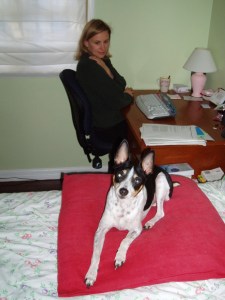
Budman 1From the start, he was there, when I first got into the writing scene, when it moved beyond keeping a sporadic journal, or writing letters. I would write and he was there, watching me, hoping at some point that I would get tired and peanut butter would eventuate. He liked to sit beside me, and by beside me I mean he got as close to the edge of the mattress as he could because my desk was right next to the bed. Later, when I moved the bed into another room and turned the front bedroom into my study, he’d hop up on the little couch and have a lie down, keeping his slightly buggy eyes on me as I hammered away at a story, hoping for peanut butter. Or a carrot, or cheese, but mostly for peanut butter.

My Little Buddy, my Budman was my companion for every book I have written. Every book. When I wrote him into Next to You he was 3. Caroline, the book’s heroine needed a companion, one who loved her unconditionally and fiercely. I gave her a Rat Terrier–my Rat Terrier. By the time I had three other books published, and Next to You was with my editor, Budman was almost 16, and he’d CHIN NextToYou1920_1920x3022_1024gone grey and blind. But he still sat beside me, his clouded, sightless eyes still set in my direction, hoping I’d break for peanut butter. He’s been gone since last August. I miss him, his warm little black and white body, his erect, bat-like ears, his slightly buggy brown eyes framed by a black mask that made him look like a canine version of Batman.

I didn’t realise that when I wrote him into Next to You, all those years ago, that I’d have such a bittersweet memorial to to my dog now. It’s weirdly fitting that Next to You deals with grief and the expectations that surround all that grief does or doesn’t entail, ideas of how one ought to behave when grieving, what’s considered appropriate, what’s considered crazy. Losing a companion animal, a dog, cat, ferret, whatever animal that was a loved part of your family hurts. A lot. The grief isn’t any different than losing a human family member. There is still an expectation of how one ought to behave when grieving, what’s considered appropriate, what’s considered crazy, yet there is also often an expectation that you only “lost a dog”  and that you should “Get over it” or just “get another dog.”

Expectations blow as much as the asshats who tell you that you should be grateful that you only lost a dog.

Whether it’s for a human friend or a canine companion you lost, grief is different for everyone. It’s a mystery to why there are expectations around how to grieve and how to act when you grieve. I tried to show that as part of Caroline’s story. Part of her grieving process meant having Batman.

This post is part of my grieving process. It’s been nine months and it still hurts. I’m not ‘over’ losing my dog. I’m not done crying about it. I’m ready to get a another dog, but my husband isn’t. You know, in some way I’m grateful that my little peanut butter-loving dog lives on as Batman in Next to You.

I’ve immortalised him.

Next to You Coming July 25th.

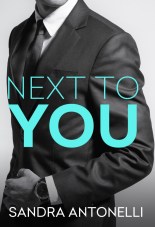
A love of ‘70s Bubblegum pop music isn’t the only unusual thing about William Murphy—being a six-foot-three albino tends to make a man stand out. Will’s life is simple and he likes it that way. But when he meets his new next-door neighbor, complicated begins to look mighty attractive.

Caroline’s left the past behind and is trying to grab life by the balls, which means finding new friends besides her dog, Batman. Will offers her neighborly friendship, and as they bond over old movies, Caroline regains her confidence. Unexpected love blooms. But real life’s not like the movies.

Their cute romantic comedy goes all Fatal Attraction and Will learns that nothing about Caroline is quite the way it looks. His simple life turns more complicated than he could ever imagine.

When A Character is Born of the Fruit of Bubblegum Pop

All it took was one song from my music library and there he was, big, very fair, naked, standing in the shower shaving–and singing The Partridge Family’s I Woke Up in Love This Morning.

I saw him so clearly. Everything I needed to know about William Murphy was contained in two minutes and 38 seconds of a well-crafted but manufactured sugar-sweet bit of Bubblegum pop genius.

That moment doesn’t explain William’s albinism except that’s how I saw him and his very essence came down to a love of expensive suits and hook-driven, upbeat, teenybopper tunes from the 60s and 70s. And I knew I had to set him against the backdrop of a romance. That romance is Next to You and it comes out in July.

You might ask ‘What is Bubblegum pop, Sandra?’ or say, ‘Wait, I thought you said you were all about Powerpop, Sandra.

To answer the latter:  I am all about Powerpop, which isn’t as sweet (or saccharine) as Bubblegum pop, but William Murphy is all about Bubblegum pop.

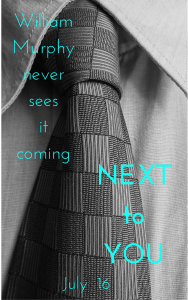
Yeah, okay, great. But what is Bubblegum pop?William Murphy never sees It coming

Prepare for a music history lesson:

Intrinsically catchy, sunny, and targeted at a preteen audience –rather than middle aged men–Bubblegum Pop was simple and melodic, the music and lightweight lyrics often about happiness, love, and candy. With repetitive hooks, simple harmonies and simple chords, Bubblegum was often manufactured, created by record producers who hired session musicians—like Andy Kim and Ron Dante, to play and sing the songs.

Often considered to be contrived and production-driven, Bubblegum groups were often given fake names to present the illusion that they were a ‘real band’—The Partridge Family and the Archies, for example. Some groups like The Monkees were real musicians brought together by producers, but played as real band. Occasionally a single artist would provide vocals for several groups, such as Ron Dante’s lead vocals for The Archies (some of you might remember The Archies cartoon) and The Cuff Links. Other artists like David Cassidy (who went on to later solo fame) and Shirley Jones appeared on The Partridge Family television series, and provided vocals for the eponymous musical act, while supported by session musicians.

http://www.youtube.com/watch?v=h9nE2spOw_o

Most Bubblegum bands were one-hit wonders, however, Bubblegum has a left long legacy of songs reflect the upbeat, catchy simplicity of the music and memorable titles such as Sugar Sugar, Yummy Yummy Yummy, Hanky Panky, Dizzy, Mony Mony, I Think I love You, and memorable acts like The Ohio Express, Tommy James and the Shondells, The Partridge Family, The Monkees, The Osmonds, The Jackson 5, The Bay City Rollers, The Sweet and so many more.

William is simple, upbeat, sweet — naturally I have a playlist for Next to You–and it’s full of William Murphy’s beloved Bubblegum pop tunes.

I bet you’re dying to know what’s on it.

By the way, THIS is Ron Dante, who gave a marvellous voice to cartoon Archie Andrews’s lead vocals. And what a totally bitchin’ sunny and catchy song it is. I bet you’ll hum it all day.

http://www.youtube.com/watch?v=TSP0e5rXUl8