April with a touch of May (via Shallowreader

My hat’s off to the librarian who swears like an dinky-di Australian and talks about female comedians dropping the balls when it comes to being funny, being crass, and being an ageist stereotype of ‘what not to wear.’

Vassiliki Veros and I met and bonded on Twitter, before we met IRL. I love her. She’s a PhD candidate and, well, a librarian who reads a lot and loves, loves, LOVES books and reading.

She’s got it in her head that heroes would rive hatchbacks–by choice, but I don’t hold that against her. In this post she talks about deselecting books in the library (I’ll let you read her post to find out what that means), being in a reading slump–which happens to everyone I know who has done a PhD, myself included–presenting a paper at the upcoming  Genre Worlds conference, going to Canada & the USA  for the Romance Readers Meetup, where she’ll meet MORE acepants twitter folk (I’m totally jealous), gives an overview of what she is managing to read, gives us a cool pic of herself wearing AND ROCKIN’ pigtails with a pussy hat, before she gets down to a review of seeing comedians bitch about women of a certain age wearing pigtails.

Check out Vassiliki’s Shallowreader blog post.

shallowreader's avatarShallowreader

I just realised that it has been a while since I wrote in my own shallows so I am going to use April’s Bingo sheet and SuperWendy’s super convenient TBR challenge topic of “Something Different” to describe my last 2 months of life as well as my reading:

Now (contemporary)

I have been incredibly busy. After a 12 month break, I am now teaching Digital Literacies at my uni’s pathway college. The content is really engaging and it is proving to be quite a different teaching space to what I am used to.

Dark Apollo

I continue to work twice a week at a public library in a ‘burb far far far away from my home. I am in awe of the excellent study culture in the community I work for. It is such a buzz seeing youth so deeply engaged in their studies. I am also a deselector for my…

View original post 1,916 more words

Loving the Beast: Or What I Learned From Loving the Villain

Luke Evans as Gaston. I approve.im-such-a-bad-boy

Everyone thinks the story Beauty and the Beast is about Belle and the Beast, a cursed prince, but really it’s about Gaston’s ability to expectorate, decorate with antlers, and his slide into hell.

You can keep your pure-hearted heroines and heroes. I’ve always liked fairy tale villains best. Villains give a better example of what it means to be truly human. Villains face or ignore their own shortcomings. Villains illustrate the concept of free will. Villains demonstrate human frailty, human morality. Villains illuminate how to and how not to behave if one wants to be loved, accepted, and admired. We learn more about ourselves from the villain’s actions than we do from the heroine’s or hero’s actions.

Heroines and heroes can be kind of boring, particularly if they are all goody-goody, principled types. Why I think Cinderella is boring as dry grass is that I never learned anything from her, and I never learned anything from Sleeping Beauty, from The Little Mermaid, or Snow White either—other than if you’re pretty people hate you. But I learned plenty from the evil stepmother, nasty stepsisters, and The Evil Queens: If you do something mean it will, eventually, bite you on the ass and lead to your downfall.

Best to avoid being mean.

I love a well-fleshed out villain, but what I love even more is a character who has villainous traits. For me, what makes Mr Rochester far more interesting than Mr High Morals Darcy is that Rochester has a secret, a screaming wraith of a secret that makes him deceitful. The secret is in the attic and it very nearly ruins him. What do we learn from Rochester’s villainous behavior?

Polygamy is bad and don’t keep secrets from the woman you love.

queen2Naturally, my love for a bit o’ badness points to the usual discussion about ‘niceness,’ as in how the leads, particularly the female lead in a romance novel, must be ‘nice,’ never nasty or bitchy, which points to the double standard discussion about how women ‘ought to behave,’ and how older women have been maligned for centuries, which points to a discussion on social mores blah, blah…

I want more female leads in romance fiction to be villainous, to have villainous traits the way Scarlett O’Hara and Rochester do. While Scarlett’s behavior in Gone With The Wind would never be questioned if she had been a man, she is, like Rochester, a perfect example of how good people, men and women, do bad things to protect what they love.

Yes, that is what I learned from Scarlett O’Hara and Mr Rochester.

What I learned from fairy tales wasn’t be pretty, be tidy, kiss frogs because they may be princes. My education came from the villains. I learned to never pretend to be something I wasn’t because that would get me shut up in a cask stuck with nails and dragged through the streets. I leaned to never be wicked to others because that would get me shut up in a vat with poisonous snake and then boiled in oil. I learned to be happy and grateful for what I have because, like the materialistic fisherman’s wife, I could lose it all in a flash, and its only ‘stuff.’

In Beauty and the Beast, Gaston’s utter ruin teaches us how to be human far better than the Beast does when he is transformed by love. Gaston’s transformation from man into a real hellish beast shows us that the villains are the true teachers in fairy tales and in life.

Older Broads Are The New Box-Office Powerhouses. Are You Listening Romance Publishers?

Wielding my Shield of Smartass

Wielding my Shield of Smartass

As part of the ongoing expansion of The “Mature” Content Stockpile of articles regarding women and age on this website, I keep track of news and other items I can add to the stockpile. When I came across this fab piece by Mark Harris from NY Mag over at Vulture you know I fist bumped myself, and OH YEAH MAMA-ed while I jumped all my about my kitchen. I was so loud, so exuberant, the builder installing insulation in my garage called out to to make sure I hadn’t hurt myself.

The article is titled Actresses Over 60 Are the New Box-Office Powerhouses.  As I read, the line that first stood out is pretty much what I soapbox about on a regular basis. Harris mentions “society’s tendency to write off older women as dear little “characters” without passions or aspirations of their own.” Then Harris goes on to discuss a 1968 study in Hollywood that examined the age demographics of film-goers.  It’s that paragraph that truly hits home; it’s what I say about a certain overlooked demographic of romance readers with an appetite for a certain overlooked subgenre of romance fiction–the Older Romance, Mature Romance, Mid-Adult Romance, Seasoned Romance, Contemporary Adult Romance. 

The audience is real, and so is its appetite. And those who get it — who don’t simply view this particular group of movie lovers as the “about to die” demographic — may, a few years hence, look like very smart early adapters. In 1968, well before demographics were a subject of serious discussion at the studios, Variety reported the results of a study that showed 48 percent of American moviegoers were 24 or younger. For the middle-aged men who then ran Hollywood and thought they were making movies for themselves, the news was revelatory. Baby-boomers — the pig in the python — were coming of age, and over the next 15 years, the way movies were conceived, made, and marketed would undergo a revolution as a result. Now, almost 50 years later, that demographic is coming of old age, and making itself heard again. And if anyone wants it, they’ve still got money to spend. —(Harris, 1 Aug 2016)

Did you notice that first line Early adapters are smart?

Did you notice the last line? That last line means I have to rewrite a small part of an academic paper I am presenting at the upcoming University of Love conference in Adelaide, Australia. My paper is titled The (Saggy) Bottom Line: Women of a Certain Age and Romance Fiction. I have to include what Harris says alongside what a few other studies and authors note. That last line is a big fat flag I wave when I’m on my soapbox, a big fat signpost that is being overlooked by the publishers of romance fiction.

In case you missed it, because romance publishers miss it, so it must be easy to miss, that big fat signpost is MONEY.

I’ve said it before, I say it in my paper presentation, and I’ll say it here again, There is a demographic of romance fiction readers  who MATCH this demographic of film-goers, and this demographic wants romance fiction that reflects the reality of their lives, not some hackneyed stereotyped bullshit about how a woman over 40 is dead below the waist, or, as Harris mentions, are people who buy “adult diapers and medic-alert systems and sit in their adjustable beds leaning forward with ear horns to make sure they hear the list of dangerous side effects in the commercials.”

This demographic wants romance fiction with heroes and HEROINES who are whole, intelligent, vibrant, active, sexual human beings, not diaper-wearing crazy, cat-loving, dried-up-old grannies with walkers. This demographic of romance reader wants a romance heroine who is like any romance heroine, only she just happens to be older. This demographic of romance reader is trying to make itself heard, and they have money to spend.

This Demographic HAS MONEY TO SPEND! What are you romance publishers waiting for? Early adapters WIN! Romance has been the Early Adapter of so many social changes regarding women– until now, and the industry is missing this goldmine right in front of them.

Thanks to Mark Harris for making me have to rewrite a small section my paper. I have to include this article because he’s given me more evidence that the romance publishing industry is overlooking a goldmine.

The Ick Factor and You: The Origin of the Notion Older People Having Sex Is Gross

Sometimes it doesn’t take much for me to jump on my soapbox. Last week, after I read Ann Brenoff‘s column Dear Hollywood, I May Be Invisible To You, But I’m Very Real on the Huffington Post I got in quite a lather (see what I did there, soapbox, lather?) with another reminder of the ‘culture of invisibility’ in Hollywood. You know the thing, that misguided idea that deems any woman over 40 as unviable, unwanted, unfuckable, unbankable onscreen. All lathered up, I pondered, again, the source of the idiotic invisibility. Since I have a PhD and wrote a dissertation that examined the culture of invisibility in romance fiction, I’m going to share my theory with you.

wtfRemember when you were 5 years-old, and your mother explained the penis and peegina* sex thing that time you were precocious and asked at the dinner table one night? Remember when, a short while after learning the revolting details of where babies came from, you realized that all the kissing you saw on TV, and in movies, was another incomprehensibly revolting thing that grown-ups like your parents did, and you thought every time your parents kissed they were trying to make a baby and you couldn’t fathom WHY your mother would let your father put his penis in her peegina?

Do you also remember how incredibly disgusted you were, but how your confused little kid mind tried to make sense of how you didn’t get pregnant when Raymond Michaud kissed you that time you played in the treehouse the big kids built in the woods near your house?

Remember when the whole notion of sex was absolutely repugnant and then one day it wasn’t? It didn’t seem that far-fetched or icky. But then, when you were about 11, your older brother told you about anal sex and you were all sex was never going to be something you did.

Ever.

Remember when you were 17 or 19, or 22 and kissing and sex was like perpetual springtime and a raging thunderstorm of emotion and passion and excitement? Remember when you joined the club you never thought you’d join? You wondered how you ever thought sex wasn’t something you would want to DO and be DONE TO, and you finally, FINALLY got why everyone on TV, in books and movies wanted to do it. Everyone had sex, all the time—except your parents.

Or grandparents.

Or your unmarried, forty-something aunt.

You thought this because never saw parents or grandparents or spinster aunts on TV, in books or movies doing it or even interested in doing it. They were too mature, tool old, too busy with work and retirembunsent, and went to bed early after their 4:30 dinnertime. And movies, books, and TV didn’t lie. The message was subtle, but you noticed, unconsciously, that people only ever had sex when they were young. You never saw people over 40, like your grandparents, kissing or groping, grinding, or dry humping on TV, in books or movies, and because you never saw it the idea of people over 40 kissing—or humping—was as incomprehensibly revolting as your mother letting your father put his penis in her peegina. The only reason your parents and grandparents still kissed was because they were Italian, Italians are affectionate, and that sort display of affection was allowed on TV, in movies and books. Your parents and grandparents weren’t really passionate because passion was for the young. The perpetual springtime raging thunderstorm of emotion and passion and excitement was for the young you saw on TV, in movies, in books, in romance fiction.

The images of youth are everywhere in the media, on TV, in books, movies, advertising, and this is the insidious way the Ick Factor is enacted. You are indoctrinated without knowing. You are misled to believe sex and passion is only for the young since that is all you see. This perpetual lack of truth is the way stereotypes of age and sex are maintained. The erasure of a huge portion of the population from view has led to the notion that sex is something only human beings under 40 want and enjoy. But it’s worse. If you’re a woman, you notice there’s a double standard when it comes men and women and sex. As you get a little older, maybe when you hit 30, you realize there’s an additional aspect to the Ick Factor you didn’t notice before, when you were younger. Men over 40 continue to get it on in books, movies and on TV.

Women grando not.

Even more sinister is way the Ick Factor works, the continual lack of truth is the way stereotypes of woman and age are maintained, the way women over 40 are cast in stereotyped roles (Hey, grandma!) or dismissed, excluded from appearing on TV, in movies and books. This is truly incomprehensibly revolting, and this is how we are conditioned to think. We erase women over 40 from being when we know this is NOT how women over 40 are.

In a world of reality television, isn’t it time to change the Ick Factor to a Truth Factor? Isn’t it time we show life as it really is, show people of all ages as whole, passionate, sexual human beings in love? Isn’t it time we grow up from being grossed out little five year olds who can’t comprehend how mommy would let daddy put his penis into her peegina?

I battle the Ick Factor. I write books that challenge the ‘younger’ norm of romance fiction. My lead characters are all over 40; the romance heroines are older than the standard twenty-something romance heroine.  The women I write are whole, intelligent, vibrant, sexual humAntonellicoverssmallan beings, not stereotypes of age. I write outside the norm because I believe it is beyond time to change. Discussing the Ick Factor and the ‘culture of invisibility’ is excellent, important, but what good is all the talk about age discrimination and sexism if no one challenges the ‘usual?” For decades, Romance fiction has been at the forefront of adapting to social and cultural change for women. What better place to shift the attitudes about women age, sexuality, make women of a certain age visible, and kill the Ick Factor?

Trust me on this. I’m a doctor who writes romance fiction.

*Becasue Pee comes out of a boy’s penis and pee comes out of a girl’s peegina

Next to You and An Introvert on Book Release Day

NextToYou_V1_FINAL Round3-Harlequin1920_1920x3022It’s BOOK RELEASE DAY for Next to You

This is the point where there are a choice of ways for me to react. Let’s examine them and break them down.

I could have a Book Launch Brunch, except… As much as I LOVE the breakfast-lunch amalgam that allows others to imbibe and relax with alcohol whilst I get hyped-up on caffeine, I’m an introvert who hates parties where there are more than six people, and no one, except me, would get up and boogie to the Partridge Family’s I Woke Up In Love This Morning from William Murphy’s Bubblegum pop classics playlist if there’s hollandaise, coffee, and booze.

I could be obsessive and check my sales rank on Amazon, today and tomorrow because it’s July 25th here in Australia, but not yet in the UK or North America. However, Amazon boggles my mind and means nothing much at all to me, except for the fact that I’ll eventually get a royalty statement showing that I made enough money from selling a few copies of Next to You to allow me to buy three to ten cups of coffee.Antonellicoffe

Those three-to ten cups of coffee—OH WHAT JOY!!

It’s a proud moment and I’d like to burst into my favourite local café and shout COFFEE FOR EVERYONE, which, for me is the equivalent of popping a cork on something, tossing confetti and SQUEEEING and stuff…except that introvert, more-than-six people thing again, and I SQUEE better on paper. So I’m gonna go to my favourite local café and continue writing my new book at my favourite table in the corner, and have 2 cups of coffee that, thanks to my readers, my royalties have allowed me to buy. And coffee OH WHAT JOY!

I’m really, really incredibly happy to have William Murphy and Caroline finally meet and have you meet them. Thank you for sharing this moment with me and, well, if you happen to stop by and see me at my favourite café, know that I am truly enjoying the coffee you bought me when you bought my book. 

The F*ckable Silver Fox Romance Heroine And Me

If you have a psyche of a sensitive nature, one that detests off-colour language, you may want to look away now because I’m about to drop some f-bombs.

By now you’ve probably seen it, Amy Schumer’s Last Fuckable Day. If you haven’t here’s a link to it.  Go watch it now.

If you don’t want to watch it, in a nutshell, the skit addresses the ageist and oh-so-sexist double standard in Hollywood. You know the ageist double standard I mean, don’t you? It’s that thing when an actress reaches an age grannyand is suddenly put out to pasture, or only offered stereotyped roles like mother, cougar, knitting grandma, and crazy hag cat lady, because they’ve crossed The Line of 40 and are no longer considered ‘fuckable’— or bankable. It’s that thing that doesn’t happen to men in Hollywood.

It also that thing that doesn’t happen to heroes in Romance Fiction.

In Schumer’s Last Fuckable Day, Amy and her pals, Tina Fey, Julia Louis-Dreyfus, and Patricia Arquette point out a woman’s ‘use by’ or ‘best before’ date in Hollywood, the enduring stereotyped roles available to an actress of a certain age, and how their male counterparts fail to suffer the same fate when they cross The Line of 40. You see, Silver Foxes, like George Clooney, are welcome in Hollywood as much as they are in romance novels. And in romance novels silver fox heroes are a hot and sought after hero.

Like in Hollywood the silver fox romance hero is usually paired with a younger woman. Like in Hollywood the silver fox moniker applies only to men. There are those of us who are tired of this ageist and sexist double standard. There are those of us tired of being told, ‘Sorry, you’re over 40 and no one wants to fuck you onscreen or in the pages of a romance novel.‘ To that I say, bullshit, there ARE people who want to see thosCGAHe movies and read those books. There are those of us who have money we would spend to see those movies and read those books because there are those of us who think that, who know that, being over 40 doesn’t mean you’re done with love or sex or romance.  There are those of us (in spite of how much we love Cary Grant and Audrey Hepburn in Charade) who’d like to see the silver foxy hero paired with a woman his own age. There are those of us who want to change things, who want silver fox to apply to women who have crossed The Line of 40.

Yes, I’m one of those who wants to change this because, goddamn it, I’m over 40 and I’m a silver fox, not a dumpy middle-aged hausfrau who’s dead from the waist down, and I’m tired of seeing women like me left out of movies and books. I’m so over seeing Daniel Craig’s late 40s SPECTRE James Bond get paired up with the then 20-something Lea Seydoux instead of 50-something Monica Bellucci.

Pardon my momentary rant. I still haven’t recovered from the missed opportunity of Bond getting the RIGHT GIRL.

I write romance fiction with silver foxy men AND silver foxy women. Yeah, no, I’m not going to call her a silver vixen because cougar is already pejorative enough and there isn’t a male equivalent besides ‘dirty old man,’ which is something more perverted than a screen hero paired with a woman half his age—which keeps getting rammed down society’s throat Antonelli coveras normal.

Sorry…sorry, ranting again. Bond should have been with Bellucci.

There are those of us who believe we need a new normal, those of us who believe that if we saw silver foxy women on a regular basis, in advertising, on the big screen, on TV, in print that the double standard that keeps women over 40 trapped by stereotypes of age might change. That’s what I am doing, changing what I see by presenting real women in romance fiction who are not trapped by a stereotype of age, who are not cougars, grannies, or crazy cat ladies. In fact, I’m going against the Hollywood image completely.NextToYou_V1_FINAL Round3-Harlequin1920_1920x3022

My books, all of them, feature pairs of silver foxes in romance fiction, something we are lead to believe is a younger woman’s tale, which we know in real life is bullshit.

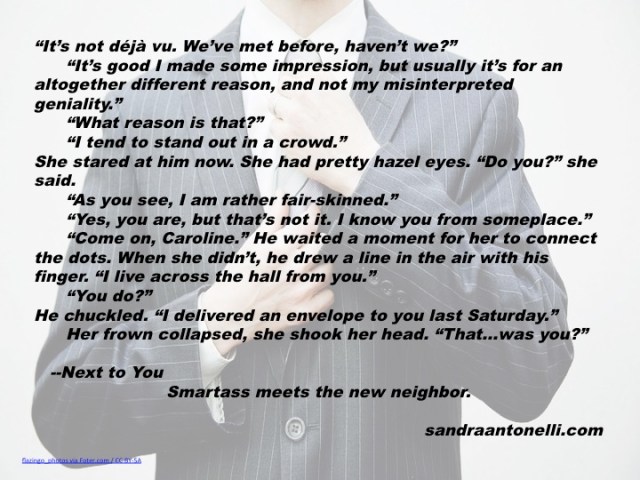
My latest release, Next to You, features a pair of silver foxes. It’s about a Bubblegum pop loving albino man named William Murphy and his new neighbor, Caroline, a woman who’s trying to grab life by the balls.  Next to You  comes on on Monday.

Ageism, Romance, and You: A Sliding Scale?

hollywoodJust when I think Hollywood is starting to ‘get it’ I come across a bone-headed article that proves otherwise. When in being considered for the role of ‘the wife” in The Wolf of Wall St, Olivia Wilde, who was 28 at the time, was deemed to be ‘too old.’ A 28 year-old actress was considered too advanced her years to play that ol’ standard role of ‘the wife to a nearly 40 year-old actor. Hooray for sexism. Hooray for Ageism.

Hollywood Old is now 28.

We’re all aware of Hollywood Old, but, as, I keep observing in the industry, there’s also Romance Fiction Old. While Hollywood Old develops at 28, in romance fiction the continuum of old appears to be on some kind of sliding scale. Honest, there is a sliding scale of old.

I belong to a Facebook group that champions ‘older’ heroines in romance fiction. This isslide-rule a vibrant group started by an author who, like me, is weary of the idea that reaching a certain age means women are invisible, heartless, and dead below the waist. The group, Seasoned Romance (fab name, innit?) consists of authors and readers who want to challenge the status quo of Hollywood Old and Romance Fiction Old. The thing is within this group of like-minded challengers the sliding scale of old is obvious. What is considered ‘mature’ shifts. There are members who think that 35 is mature. There are members (like me) who think that any age over 40 is the real mature, particularly when I have no trouble finding a 35 year-old heroine in romance, but struggle to when it comes to finding women 40 and beyond depicted as leads in romance fiction.

While mid-twenties remains the age norm for a romance heroine, there are heroines pushing 40—but few romance heroines have crossed that magical number that leads to invisibility. The 40-something heroine is becoming more popular (YAY!), more authors are writing heroines who have hit 40, or are just over 40, yet those books are not easy to find, which is why I have my list of Contemporary Romance Older Couples and keep adding to it.

Have you forgotten about my BOOK LIST? Keep your suggestions for the list coming, as many of you have—but please, no Women’s Fiction. I want romance, where the love story is central and the leads are both over 40.

Just spit-balling, here, but I suspect this sliding scale may be related to the age of the writer/reader. The variation is part of looking at age through the eyes of youth—when you’re 16 anyone 30 is ‘old’, and 30 year olds having sex is so gross, but once you reach 30, you wonder how you ever thought 30 was old because it’s 50 that is really old, and people in their 50s don’t have sex because they’re almost dead, and that’s so gross, and so forth… Hello ageism.

skeletalWhat do you think? The sliding scale; I’m curious to find out if there is a generally accepted idea of ‘old’ in romance fiction. Do you set a limit to what is ‘old’ depending on how old you are, or do you, like me, think that people, women fall in love at all ages, and those stories deserve to be told? If romance publishing is discussing diversity across the board, there needs to be dialogue regarding sexism and ageism in romance fiction, doesn’t there?

You may say I’m simply bellyaching. You may say, Look, Sandra, it’s happening. Sally Field is 69 and playing a romantic lead in Hello, My Name is Doris. That’s way, way , way past Hollywood Old! Be grateful Hollywood said yes to a 69 year-old actress having a younger man love as her interest.

Yes, I’m grateful that an amazing actress other than Meryl Streep is playing a woman of a certain age.

Yeah, kudos for Sally being THE OVER 40 LEAD! I love Sally and she needs a hell of a lot more roles. However, did Doris have to be an ageist stereotype, did she have to be just another version of kooky older lady? Okay, okay. I’ll leave that for another time.

But COME ON.

My Next Big Thing, Next to You

Writing takes time. Lots of time.

Getting published takes time. Lots of time.

Submitting queries and manuscripts takes time. Lots of time.

This book’s taken time. Lots of time.

And by lots of time, I mean this books’s taken me 12 years to get accepted for publication.

This doesn’t mean the book that took me 12 years book is published. It means it took me 12 years that consisted of 9 months of writing it, a week where a well-respected and very dear author friend of mine read it and thought it was better than the first book I wrote (Bless you, Megan for getting through that piece of shite), a year of sitting on it, a week of my very lovely one-time critique partner Gabrielle reading it, and 9 years of sitting in a box under the bed before a writers’ weekend at Rachel Bailey’s house made me think to drag it out to see if it could be resurrected, followed by rewriting, editing and rewriting, and submitting and pitching, and submitting pitching, and submitting until….

Yes, kids, my Next Big Thing is about a motorcycle-riding albino hero who loves 60s Bubble Gum Pop. it’s called Next to You Don’t know about a release date, seeing as I just got the ‘we’d be delighted to accept Next to You for publication’ email,  but you know publishing is all about waiting.

And I can’t wait for you to meet William.

NTY1

A Little Help From My Romance Reading Friends

Antonelli coverThe current buzzword is diversity. There’s been discussion about the diversity of race, ethnicity, sexual orientation, gender and age discrimination in Hollywood. There’s been discussion regarding diversity in romance fiction as well. In an open letter to its members, the Romance Writers of America has addressed the importance of the romance industry being diverse and inclusive of race, ethnicity, gender, sexual orientation, and disabilities.

Kudos to the RWA and thanks for coming to the party. Just one thing with your diverse list. You forgot to be inclusive of age. 

Are you over 40 and feeling invisible in romance? Don’t. Someone’s thinking about you.****

You all know how I have books and short stories published and out there.

You know how all my books and short stories all feature heroines and heroes over 40.

You know how I blog regularly about grown ups in romance and run something I call the ‘Mature Content Stockpile‘ on this website. I need to add to that stockpile, and I’m looking to YOU THE READER for help because AGE DIVERSITY MATTERS! 

I have been wanting to collect a list of romance novels that feature ‘mature’ ROMANCE Heroines and Heroes, specifically Heroines and Heroes over 40 in CONTEMPORARY ROMANCE. This is because of how contemporary society views older women, places them in stereotypes roles, or renders them invisible

Let me be clear: I am not interested in couples under 40. I am not interested in couples who are secondary characters. I want characters who are IN their forties, fifties, or beyond, characters who are the LEADS! Nix I am not interested in ‘women’s fiction’ or ‘romantic elements.’ I am looking for romance, where the love story is the focus of the novel, rather than a mere piece of the tale. I want HEA or HFN.

The All About Romance website has a list of Older Couples books that needs updating.  I modified the AAR list and included it my PhD research. The AAR list got me started, and includes novels where characters over 40 appear as secondary characters, which I include on my booklist because those secondary romance (and short stories that feature an older couple), form a foundation where older has been ‘acceptable’ as a side tale, however, I will not include secondary romance from this point on. There is a list on Goodreads Best older hero AND older heroine romance books (the main couple has to be over 40!)  and it is FAB, but it does include books some consider Romance as there is no happy resolution or Happily For Now, e.g. Kazuo Ishiguru’s Remains of the Day (a book I love SO HARD).

Allow me to reiterate. For the purposes of continuing my book list, I am only interested in Contemporary romance novels where the leads are over 40.  I include my list at the bottom of this post.

If ANYONE can give me more examples of ROMANCE FICTION that feature heroines and heroes over 40, please let me know by leaving a comment on this post! 

****EXCITING NOTE! As of May 4 2017, Entangled has put out a call for romance fiction WITH LEADS WHO ARE OLDER!

Contemporary romance Older Couples (AAR Original is here)

Forty-Something

A Basic Renovation (2013) by Sandra Antonelli

For Your Eyes Only (2013) by Sandra Antonelli

Driving in Neutral (2014) by Sandra Antonelli

Next to You (2016) by Sandra Antonelli

Band of Gold (2014) by Maggie Christensen

Triumph (2017) By Cecilia London (Bellator 6)

Out of Control (2002) by Suzanne Brockmann (secondary romance)

Breaking Point (2005) by Suzanne Brockmann (secondary romance)

Hot Dish (2006) by Connie Brockway

For Auld Lang Syne (1991) by Pamela Browning

Eve’s Wedding Knight (1999) by Kathleen Creighton

I’m Your Man (2007) by Susan Crosby

Anyone But You (1996) by Jennifer Crusie

Fast Women (2001) by Jennifer Crusie

Full Bloom (1994) by Stacey Dennis

Fanning the Flames (2015) by Victoria Dahl (novella)

Talk Me Down (2011) by Victoria Dahl

There Is a Season (1999) by Margot Early

Comfort and Joy in Santa’s Little Helpers (1995) by Patricia Gardner Evans

Luring Lucy in Hot and Bothered (2001) by Lori Foster

Fall from Grace (2007) by Kristi Gold

The Star King (2000) by Susan Grant

Hot Wheels and High Heels (2007) by Jane Graves

Contracted: Corporate Wife (2005) by Jessica Hart

Marriage Reunited (2006) by Jessica Hart

Colorado Golden Sunrise (2017) by Jill Haymaker

Love for the Matron (1962) by Elizabeth Houghton

Where Destiny Plays by Regina Kammer (erotic)

The Westerman Affair by Regina Kammer (erotic)

The Second Chance Neighbors series by Josie Kerr

Only Yesterday (1989) by Syrell Rogovin Leahy

Dissident (2015) by Cecilia London (Book 1 Bellator Saga; characters age to mid 50s)

Conscience (2015) by Cecilia London (Bellator 2)

Sojourn (2015) by Cecilia London (Bellator 3)

Phoenix (2016) by Cecilia London (Bellator 4)

Rhapsody (201) by Cecilia London (Bellator 5)

Cold Tea on a Hot Day (2001) by Curtiss Ann Matlock

Love in a Small Town (1997) by Curtiss Ann Matlock

Stitch in Snow (1984) by Anne McCaffrey

Carved in Stone by Donna McDonald

Never Too Late by Donna McDonald

The July Guy (2019) by Natasha Moore

The Standby Guy (2019) by Natasha Moore

The Goodbye Guy (2020) by Natasha Moore

Suburban Renewal (2004) by Pamela Morsi

The Fourth Wall (1979) by Barbara Paul

Down in New Orleans (1996) by Heather Graham Pozzessere

No More Wasted Time (2014) by Beverly Preston

Black Rose (2005) by Nora Roberts

A Piece of Heaven (2003) by Barbara Samuel

Count on Me (2001) by Kathryn Shay

Promises to Keep (2002) by Kathryn Shay

Sweet Hush (2003) by Deborah Smith

Bygones (1992) by LaVyrle Spencer

The Hellion (1989) by LaVyrle Spencer

Home Song (1995) by LaVyrle Spencer

Barefoot Bay & Timeless series by Roxanne St. Claire

Nerd in Shining Armor (2003) by Vicki Lewis Thompson (secondary romance)

Without Saying A Word by Amada J Ward

The Bed & Breakfast Man by Amanda J Ward

Wings of A Dove by Amanda J Ward

It Must Be Love by Amanda J Ward

Champagne and Catnip by Amanda J Ward.

The Love Game (2018) by Maggie Wells

Play For Keeps (2018) by Maggie Wells

One Fine Day (1994) by Theresa Weir

Snowfall at Willow Creek (2010) by Susan Wiggs

Fifty-Something

At Your Service (2018) by Sandra Antonelli

Your Sterling Service (novella) by Sandra Antonelli

Forever In Your Service (2019) by Sandra Antonelli

For Your Eyes Only (2014) by Sandra Antonelli

True to Your Service (2020) Sandra Antonelli

Next to You (2016) By Sandra Antonelli

The Will by Kristen Ashley

The Long Way Home (2010) by Jean Brashear

A New Lu (2005) by Laura Castoro

Bachelor’s Puzzle (1992) by Ginger Chambers

The Sand Dollar by Maggie Christensen

The Dreamcatcher by Maggie Christensen

Broken Threads by Maggie Christensen

The Life She Deserves (2019) by Maggie Christensen

The Life She Chooses (2019) by Maggie Christensen

The Life She Finds (2020) by Maggie Christensen

This Time Forever (2017) by May Cooney Glazer

French Twist (1998) by Margot Dalton

Remember Love (1992) by Stacey Dennis

Return to Love (1993) by Martha Gross

Rode Hard by Lorelei James (erotic romance)

Turning Twelve-Thirty by Sandy James

We Were Gods by Moriah Jovan

Hot Blood (1996) by Charlotte Lamb

Choose Me (2016) by Natasha Moore

Rescue Me (2016) by Natasha Moore

Lucky Me by (2017) Natasha Moore

The 90 Day Rule by Diane Nelson

Heaven, Texas (1995) by Susan Elizabeth Phillips (secondary romance)

This Heart of Mine (2001) by Susan Elizabeth Phillips (secondary romance)

Natural Born Charmer (2007) By Susan Elizabeth Phillips (secondary romance)

The Women of Willow Bay series by Nan Reinhart

Thunder Basin by Nya Rawlins (western Rom-Suspense)

Familiar Stranger (2001) by Sharon Sala

The Best Medicine (1993) by Janet Lane Walters

A Taste of Heaven by Penny Watson

Three Little Words by Maggie Wells

A Will and A Way by Maggie Wells

A Bolt From the Blue by Maggie Wells

Tomorrow’s Promise (1992) by Clara Wimberly

The Vow (2008) by Rebecca Winters

The Duke of Olympia Meets (2016) His Match by Juliana Gray (he’s 74 she’s 50+)

Sixty-Something

Julie and Romeo (2000) by Jeanne Ray

Eleanor and Abel (2003) by Annette Sanford

Apples Should be Red by Penny Watson, novella (60s/50s)

Trust Me on This (1997) by Jennifer Crusie (secondary romance)

Seventy-something

Late Fall (2016) by Noelle Adams

The Duke of Olympia Meets (2016) His Match by Juliana Gray

Colorado Winter Moon (2017) by Jill Haymaker (60s/70s)

Mrs. Martin’s Incomparable Adventure (2019) by Courtney Milan (f/f)


That Odd in Between Time Holiday Party Introvert Writer Thing

smalltalk_zThis being the holiday season means it’s also the Season of the Holiday Party. It’s cocktail parties, BBQs, Beer and Bubbly, meeting new people, and small talk.

I totally suck at small talk. Mostly because I am an introvert, When I tell people I’ve just met that I’m a writer and I’ve had three books published, the question I am asked most is never what I expect.

I’ve garnered comments such as “Mature protagonists? You mean your books are like Fifty Shades of Even greyer Grey?” and “It’s about time someone showed that women aren’t invisible after 40!” I like that comment.

There was also the well-meant, and very cringeworthy “Mr Turnbull, my wife can show you how to sex up a cost-benefit analysis,” to which, thankfully, the now-current Prime Minister of Australia offered a gracious smile.

I’ve been asked “What do you write?” and “Do you do research for sex scenes?” and even, “Have I ever read anything you’ve written?”

Yet, the the most frequent question is “When will your next book be published?”

I find that flattering and tremendously WTF at the same time before I remember the general public has no real idea how long it takes to write a book, let alone have it published.

Rather than become indignant, I get self conscious. I’ve drawn attention to myself, and I think I better, you know, get over myself and engage in small talk. So then I get a little teachery and FEEL THE NEED TO EDUCATE!

The man with the schooner of beer is waiting for me to answer his “When will your next book be published?”

I respond with:

True, some writers are able to hammer out a story in a few weeks. Others a few months,. Me? I take about 9 months to a year. Getting the book published can take even longer; from a few months to a year or even longer if the book is in print form. I have two books out there right now, both waiting to find a home. Yes, I have a publisher, but that does not guarantee my next two books will be accepted for publication, and even if they are, there is still the editorial process. The editorial process can take months. So this book I wrote two years ago, might not come out until next year.

Then I notice that his eyes have glazed over and his beer/rum-n-coke/champagne glass is empty and I totally sucked tremendously hard at the whole small talk thing.

Ho Ho Ho, Kids.


Looking for a smartassed presents to give to those who love to read smartass?

My three books go so well with coffee!

Sandrabooks1